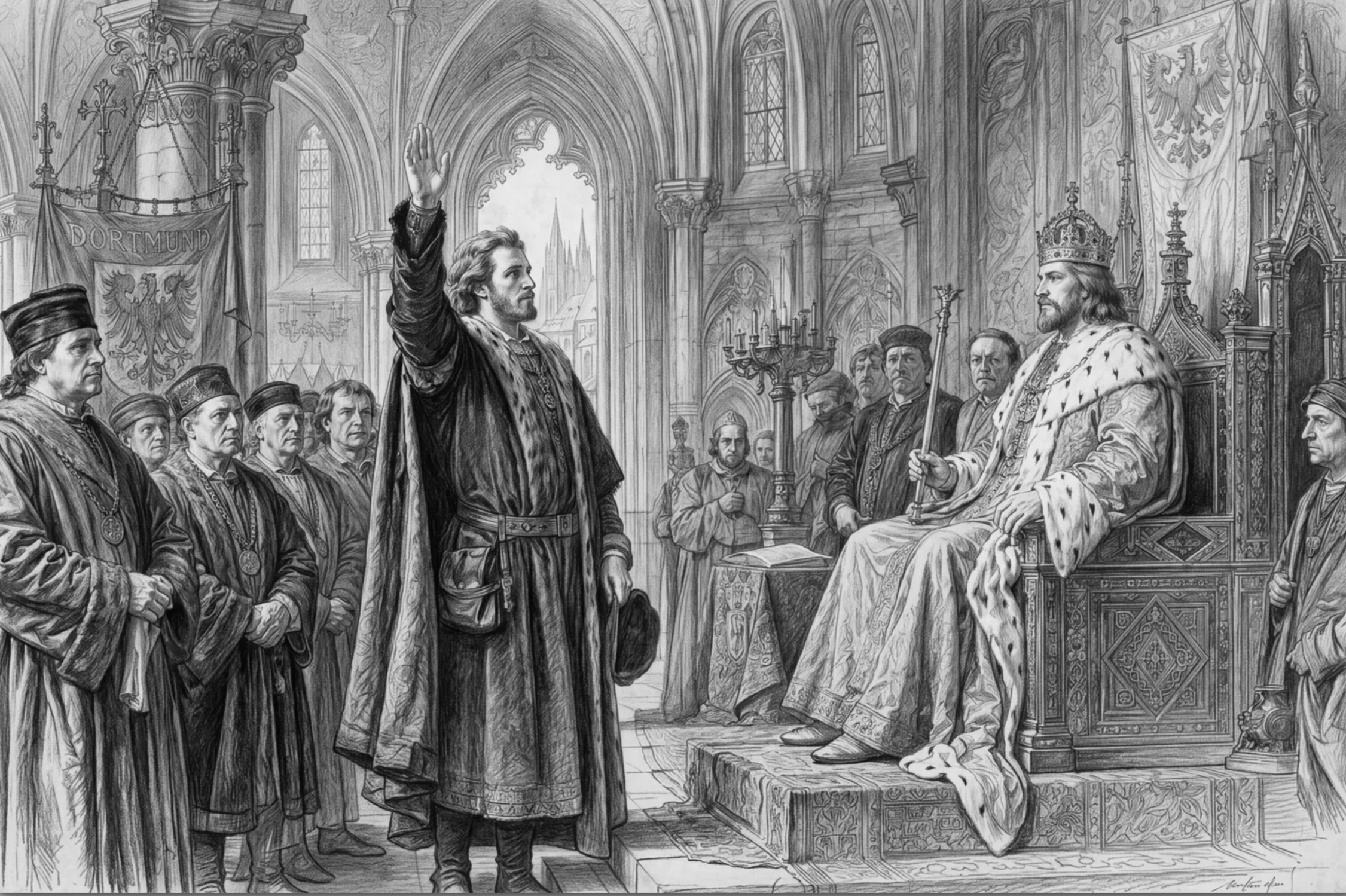
In 1360, Emperor Charles IV confirmed Johannes as Free Count. He served for at least thirteen years at the royal court seat outside Dortmund.
The oath of allegiance (reconstruction)
Key facts and family background
G03
before 1360 – after 1373
Johannes was a son of Everhardus der Vryge and Cord of Vrylinghausen’s daughter, whose baptismal name is not recorded. From 1360 until at least April 1373 he served as Free Count of the County of Dortmund. According to the chronicle, no reliable sources identify a wife or children.
Life
born before 1360 · died after 1373
Wife
not reliably recorded
Parents
Everhardus der Vryge · N. N. of Vrylinghausen
Office
Free Count of the County of Dortmund · 1360–1373
Appointment
17 April 1360 · Prague · Emperor Charles IV
Court seat
free-court seat at the royal estate outside Dortmund
Basis: Family Chronicle, Volume 1
The biographical account
One life in the Altenbochum family history
Documented facts, family relationships, and historical interpretation are kept clearly distinguishable.
01
A Free Count between town and count
Count Conrad of Dortmund and the Dortmund council jointly presented Johannes for office. Emperor Charles IV confirmed him in Prague on 17 April 1360. His authority therefore rested on the interaction of empire, count, and town.
02
The royal estate outside Dortmund
Johannes administered justice at the important free-court seat on the royal estate beyond Dortmund’s walls. Legal acts and disputes were heard there. His documented tenure until at least April 1373 indicates notable continuity.
03
Vryman, Vrygemann, and van Bocholt
The sources use different names. The presentation charter calls him Vrygemann; in his own charters he called himself Johann van Bocholt. The varying forms show that place designation and family name were not yet firmly separated in the fourteenth century.
04
What has not survived
The chronicle identifies no reliable source for a wife or possible children. This gap remains explicit. What is documented is his public activity as Free Count and his role in the regional legal order.
Source note This biographical account follows the presentation and references in Friemann aus Altenbochum—Family Chronicle, Volume 1, fourth edition, 2026. Missing partner names, descendants, and uncertain details remain explicitly identified. Historical reconstructions do not replace individual documentary evidence.