Friemann
← Return to overviewEssen‑Steele
Chapter 02 · From farmstead to industrial region
Essen‑Steele
new paths
A marriage in 1760 led from Altenbochum to Kray-Leithe. Across six generations, the family’s world changed from a rural landscape into a densely connected industrial region.
Documented in church and civil recordsFrom the family chronicleHistorical interpretation
A change of place
Only a few miles—and yet a new beginning
The journey from Altenbochum to Kray-Leithe was short. For the family story, it was decisive.
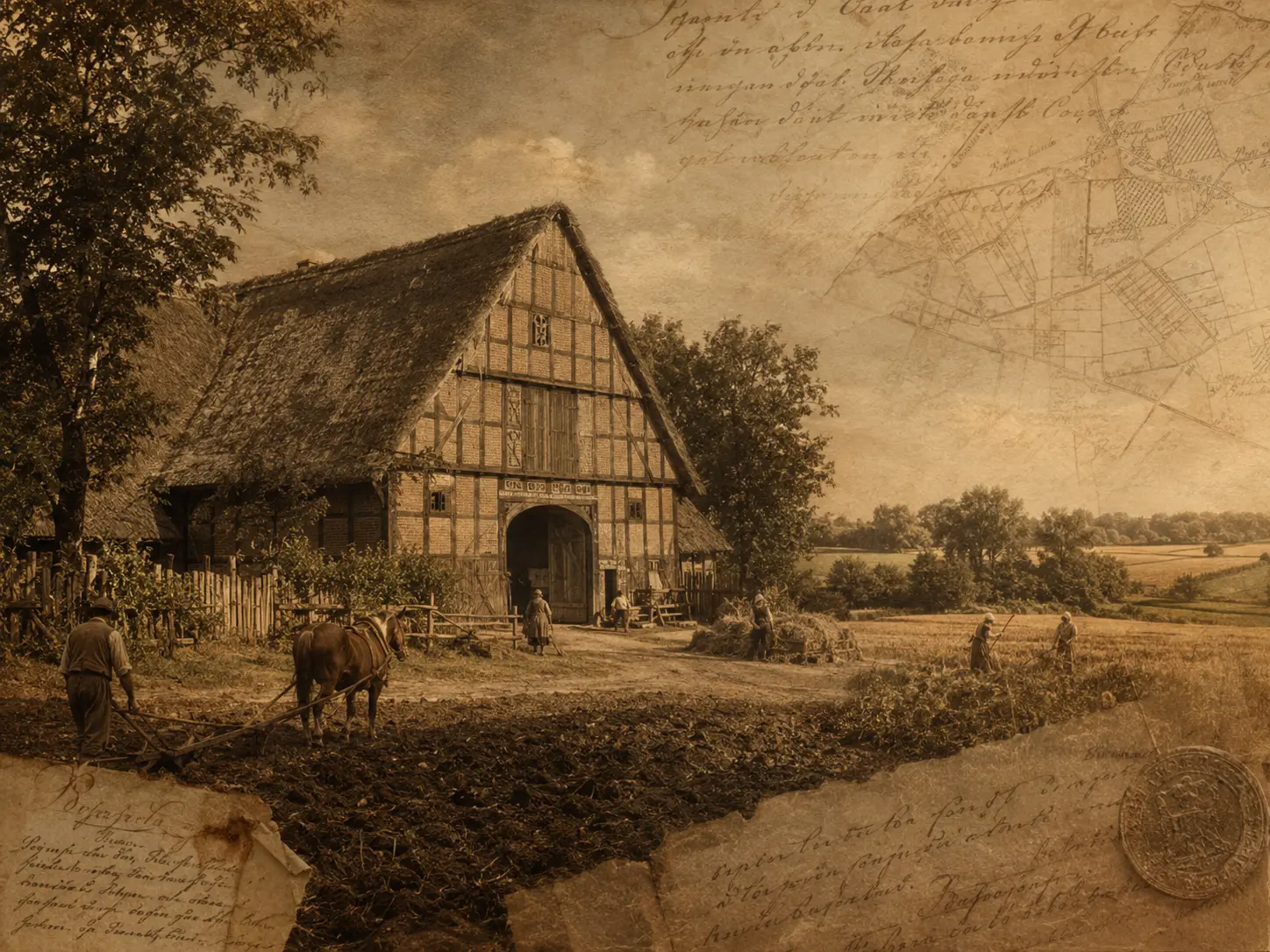
As a younger son, Georg Heinrich Friemann was not expected to inherit the Altenbochum farm. By marrying Anna Gertrud Grüggel in 1760, he assumed the position of resident farmholder, or Aufsitzer, on the Schulte Ising farm. Family name, farm name, and social role were thereafter combined in the form “Friemann genannt Schulte Ising”—Friemann, called Schulte Ising.
Georg Heinrich and Anna Gertrud
The farm name becomes part of the family name
On July 15, 1760, Georg Heinrich Friemann married the widow Anna Gertrud Grüggel at St. Laurentius. She brought five children from her first marriage to Johann Albert Schulte Ising. Georg Heinrich became the resident farmholder at Kray-Leithe; the couple had three children together.
Records call him “Friemann genannt Schulte Ising” or “Fryman gen. Ising.” The addition indicated his connection to the farm and the role he held there—not the creation of a separate family.
Source status: Family Chronicle, Volume 2, with individual referencesMarriage, burial, and family relationships follow church-register entries evaluated in the chronicle. Information supplied by FaZiT – Familienzusammenführung im Team was an important foundation. The social meaning of the farm name is a historical interpretation.
Name and position
FriemanncalledSchulte Ising
“Schulte” referred to the manager or resident holder of a larger farm; “Ising” was the traditional farm name. Church records may show several forms side by side, depending on the clerk.
From countryside to city
Steele in transition
The line remained in the same region—but the region changed fundamentally.
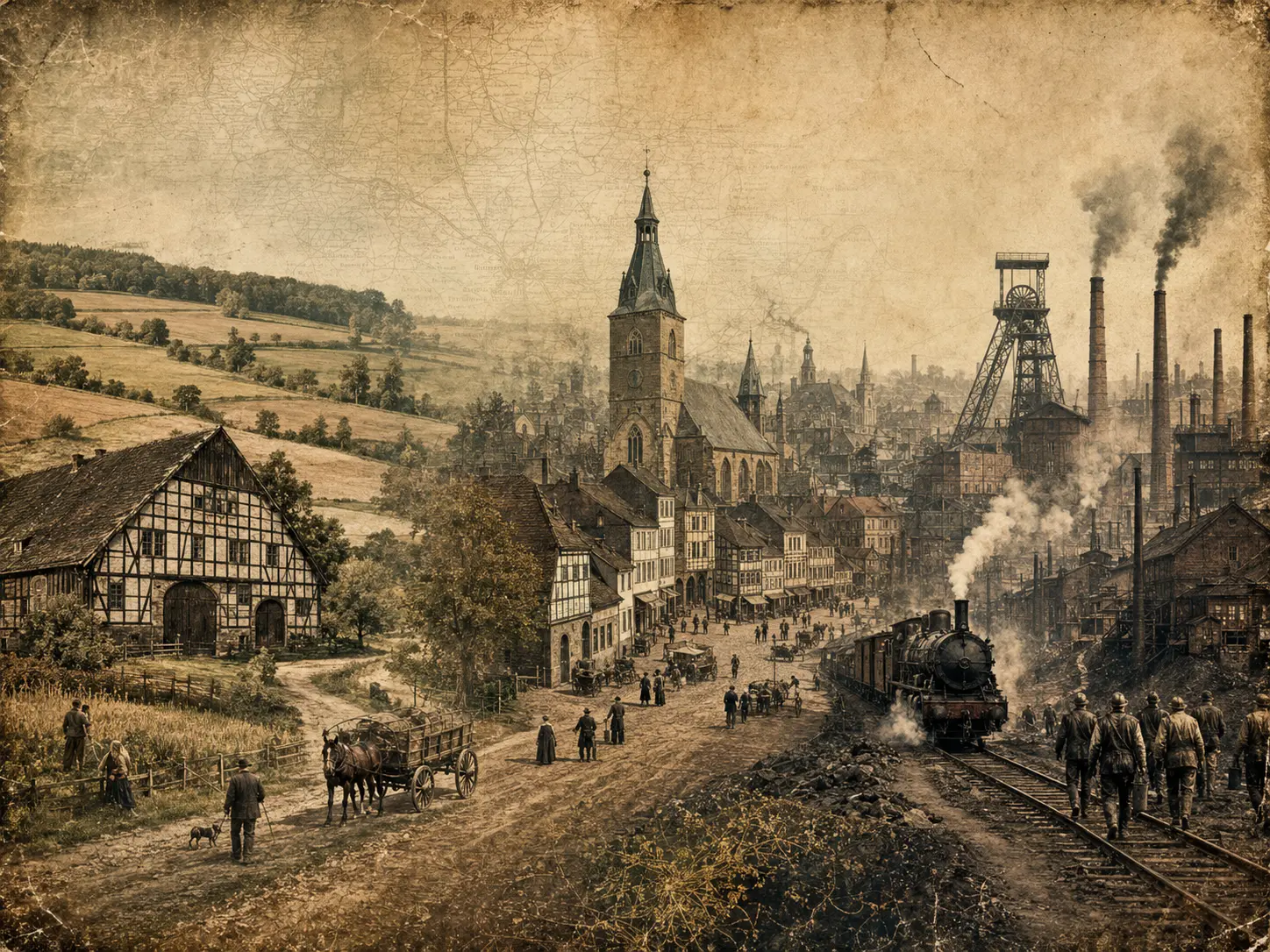
In the late eighteenth century, Kray-Leithe was still predominantly agricultural. During the nineteenth century, mining, transportation, and industry expanded, and Steele became increasingly connected with neighboring communities. The family’s successive homes—Steele, Königssteele, Niederbonsfeld, and Rellinghausen—reflect this movement within the emerging Ruhr region.
The direct line · G15 to G20
Six generations between farmstead and industrial city
1736–1809 · Altenbochum · Kray-Leithe
Georg Heinrich Friemann and Anna Gertrud Grüggel
The marriage of 1760 brought Georg Heinrich to the Schulte Ising farm.
1763–1824 · Kray-Leithe · Essen-Steele
Johann Heinrich Georg Friemann and Anna Gertrud Plümer
Their son retained the name ‘called Schulte Ising’ and later died in Steele.
1822–1890 · Essen-Steele
Johann Heinrich Friemann and Christina Elisabeth Wölting
With nine children, the family grew during the era of industrial transformation.
1848–1878 · Steele · Königssteele
Heinrich Wilhelm Friemann and Margaretha Ort
The line continued through their son Heinrich Wilhelm, born in 1878.
1878–1958 · Königssteele · Niederbonsfeld · Rellinghausen
Heinrich Wilhelm Friemann and Emma Ruhrmann
Successive homes reflect the family’s increasing mobility within the industrial region.
1910/11–1944/99 · Niederbonsfeld · Rellinghausen · Steele
Johann Wilhelm Friemann and Ernestine Schirmer
Decades later, their grandchildren Jürgen and Markus began a new chapter: researching and preserving the family story together.
Spiritual center
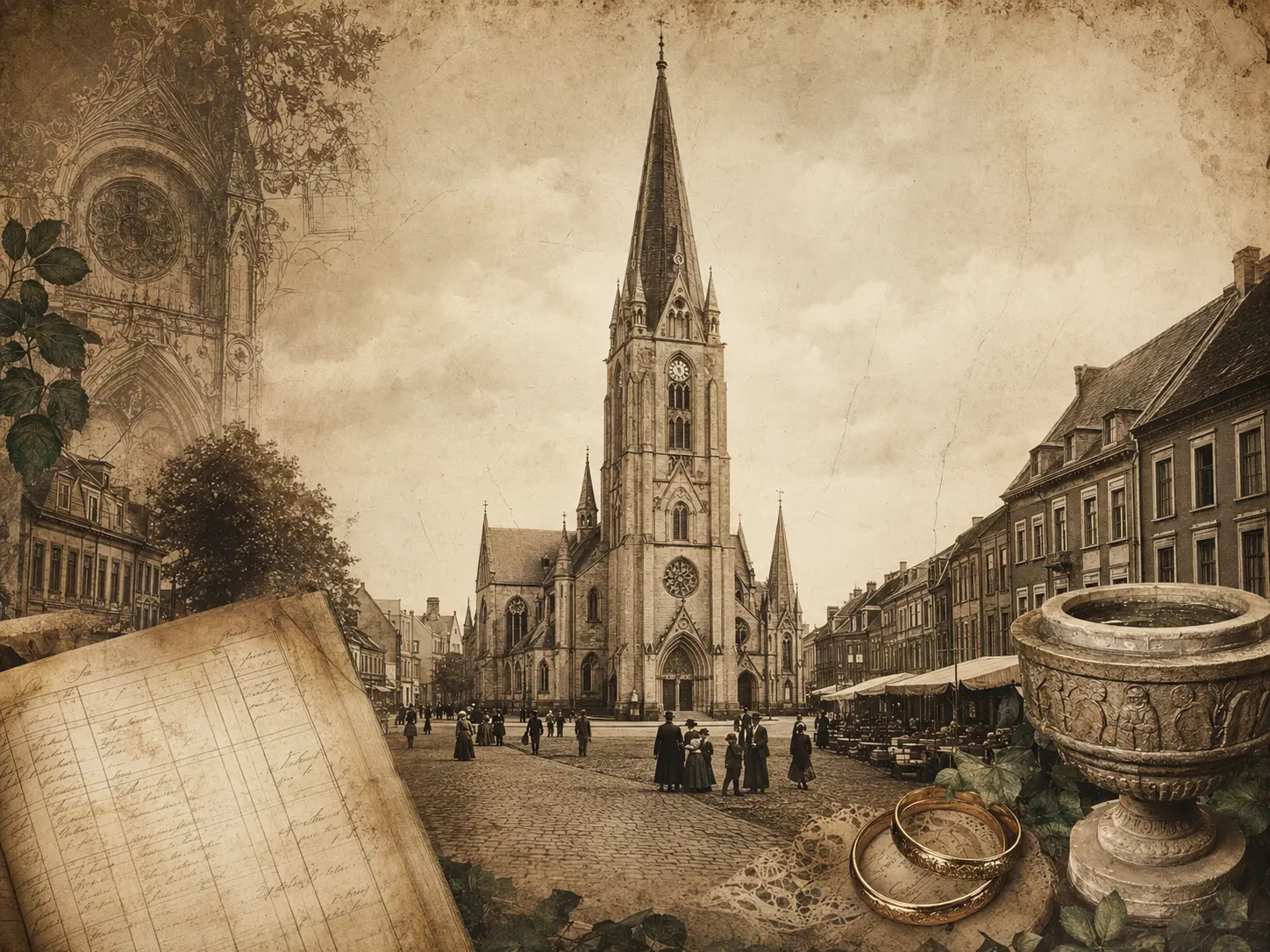
St. Laurentius in Steele
Baptisms, marriages, and burials made the parish church an important place of family memory.
Georg Heinrich Friemann and Anna Gertrud Grüggel married at St. Laurentius. Georg Heinrich was buried in its cemetery in 1809. Before comprehensive civil registration began, the parish registers formed a central source for the older Steele line.
Source status: documented through church and civil recordsSt. Laurentius recurs across several generations. This is supported by church-register extracts supplied by FaZiT and by birth, marriage, and death records received chiefly from the Haus der Essener Geschichte/Stadtarchiv.
Milestones
From 1760 to 1944
A new farm
Marriage and move to Kray-Leithe.
In Steele
Marriage of Johann Heinrich Georg and birth of his son Johann Heinrich.
The family grows
Johann Heinrich marries Christina Elisabeth Wölting.
New places
Heinrich Wilhelm and Emma Ruhrmann marry.
Johann & Ernestine
Marriage in 1933; Johann Wilhelm dies in present-day Ukraine in 1944.