Friemann
← Return to overviewAltenbochum
Altenbochum on the Westphalian Hellweg · historical reconstruction based on Family Chronicle, Volume 1Chapter 01 · Documented since 1321
Altenbochum
on the Hellweg
The known family story begins here—with freehold farmers, an ancient system of justice, and a farmstead whose name endured across centuries.
DocumentedFrom the family chronicleGenealogical interpretation
Place and landscape
A settlement of free farms in the beech woods
Altenbochum lay on one of Westphalia’s defining transportation and legal corridors: the Hellweg.
The chronicle describes an early settlement of free farms in the “Bockholt,” or beech woods. Merchants, pilgrims, and armies traveled the Hellweg, while farms and free-court seats shaped local order. In this setting, a name appeared in the early fourteenth century from which “Friemann” would later develop.
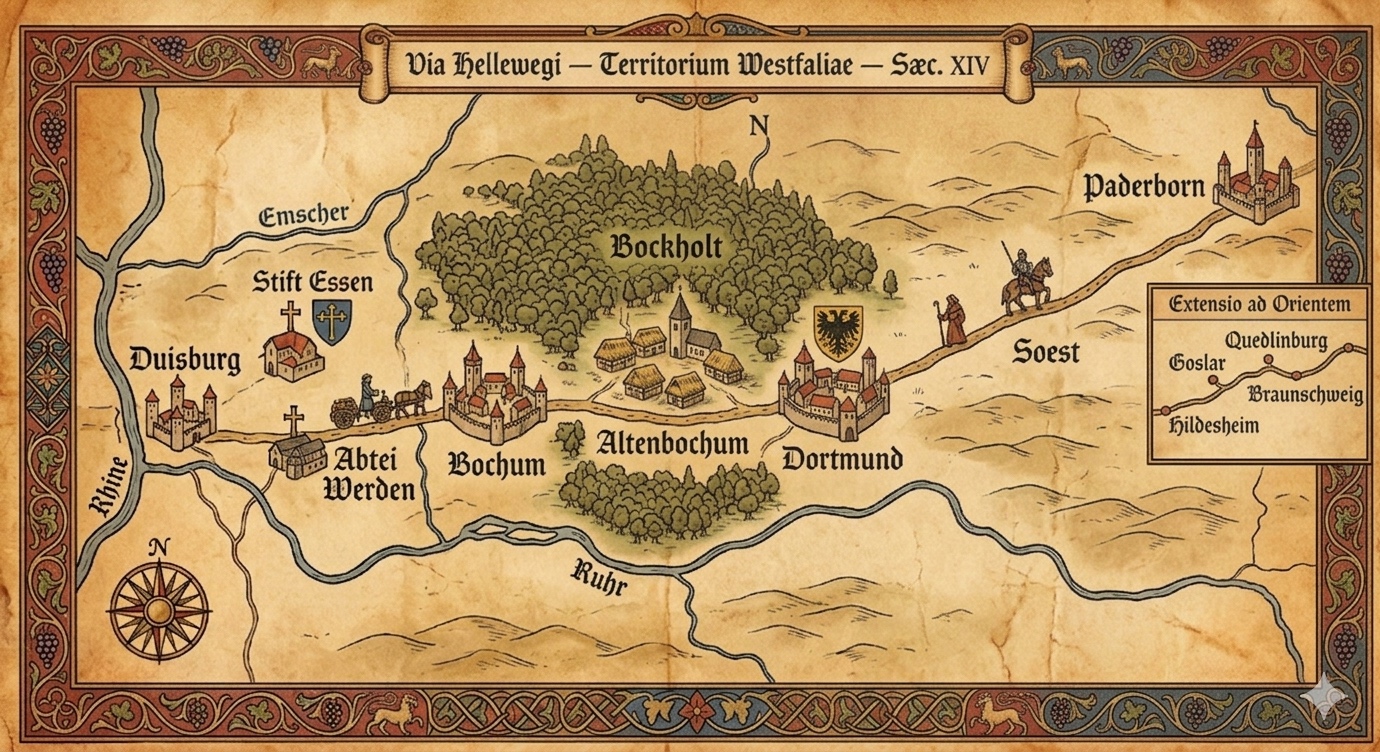
Hellweg and Bockholt
A living environment between long-distance road and beech woods
The Hellweg connected the Rhine and Weser and brought merchants, pilgrims, armies, and new legal forms into the region. Settlements and wooded areas extended north and south of this route; tradition associates them with the “Bockholt,” the beech wood or beech forest.
The forest was an economic resource, a border landscape, and a place of justice. Timber, grazing, and hunting met free-court seats and assembly places. The free farms whose owners supplied the lay judges of the Bochum free courts lay in this setting.
Source status: historical contextCompiled from Family Chronicle, Volume 1, particularly the sections on the Hellweg, Bockholt, and the free-court system.
A name changes
Vryge · Vryman · Vriemann · Friemann
der Vrygethe free man→Vrymanmedieval form→Vriemannlater spelling→Friemannpresent form
Spellings vary in the sources. This sequence is the genealogical interpretation presented in the family chronicle; it does not replace evidence for every individual stage.
Law and responsibility
The Seven Free Men of the Bochum region
In medieval Westphalia, freedom also meant responsibility for administering justice.
According to research evaluated in the chronicle, seven free farms supplied lay judges to the Bochum free courts. Their owners took part in judgments at the Freistuhl, the court’s traditional seat. The farm “Frieman zu Altenbochum” later appears among the region’s electoral freehold farms.
A center across generations
The Friemann farmstead
The farm was at once an economic foundation, a home, and a visible expression of its owners’ particular legal status. As late as 1931, the property on Buselohstraße was described as an extensive Westphalian farmstead.
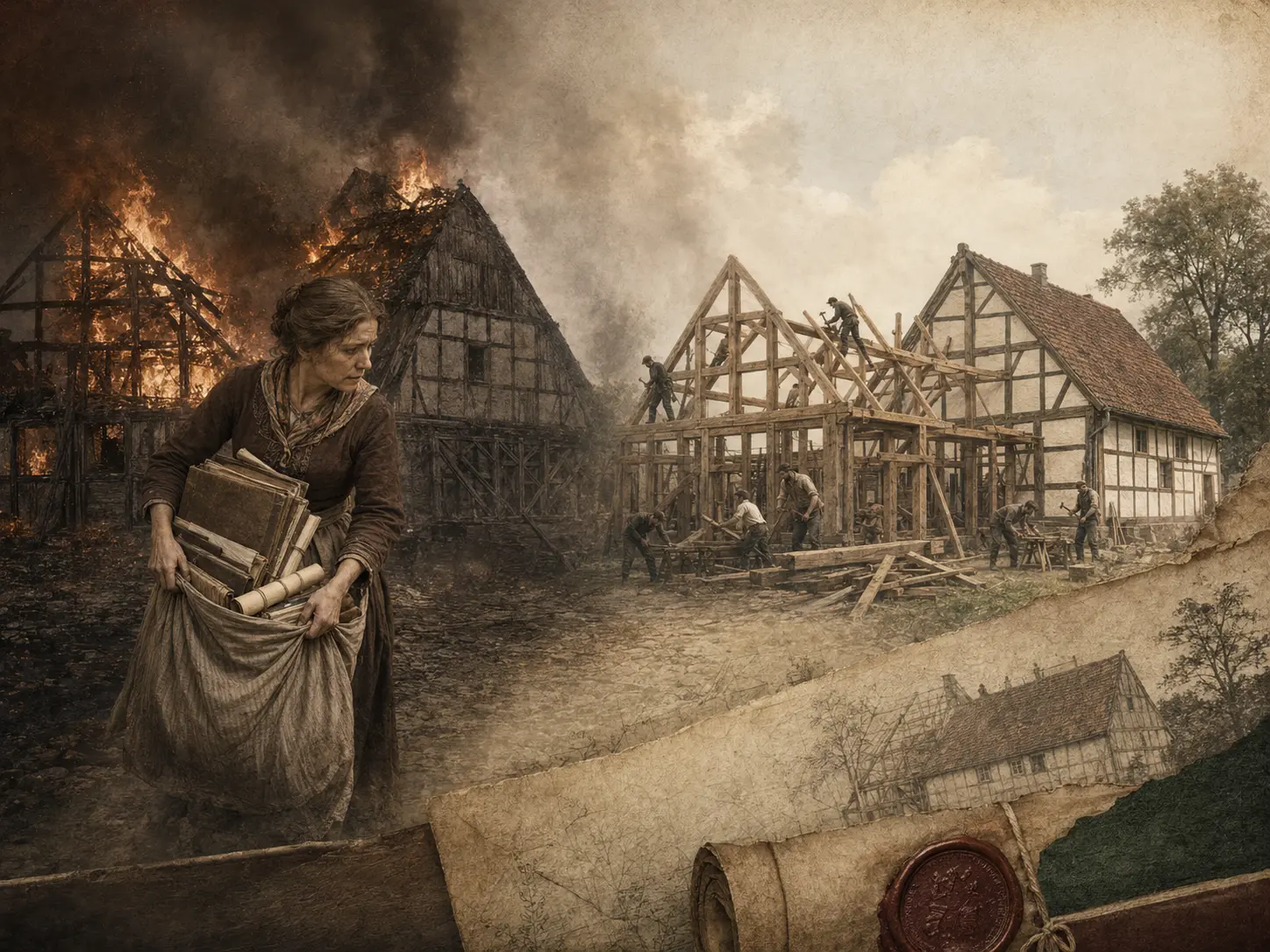
Family tradition · 1833
1833As the farm burned, Elisabeth rescued the documents.
According to the family chronicle, a fire destroyed the Friemann farm and neighboring Puttmann farm. Anna Maria Elisabeth Mummenhoff is said to have gathered the most important papers in her apron and escaped through a window.
The precise sequence is not documented in archival records and is presented in the chronicle as family tradition. The story remains central to family memory: without the rescued papers, an essential part of the historical record would have been lost.
Rebuilding · 1834
“Built in 1834 by the widow Friemann, née Elisabeth Mummenhoff, and her son Georg-Heinrich Friemann”
The beam inscription reproduced in the chronicle links destruction with a new beginning. The farm was rebuilt, and the rescued documents survived as the family’s memory.
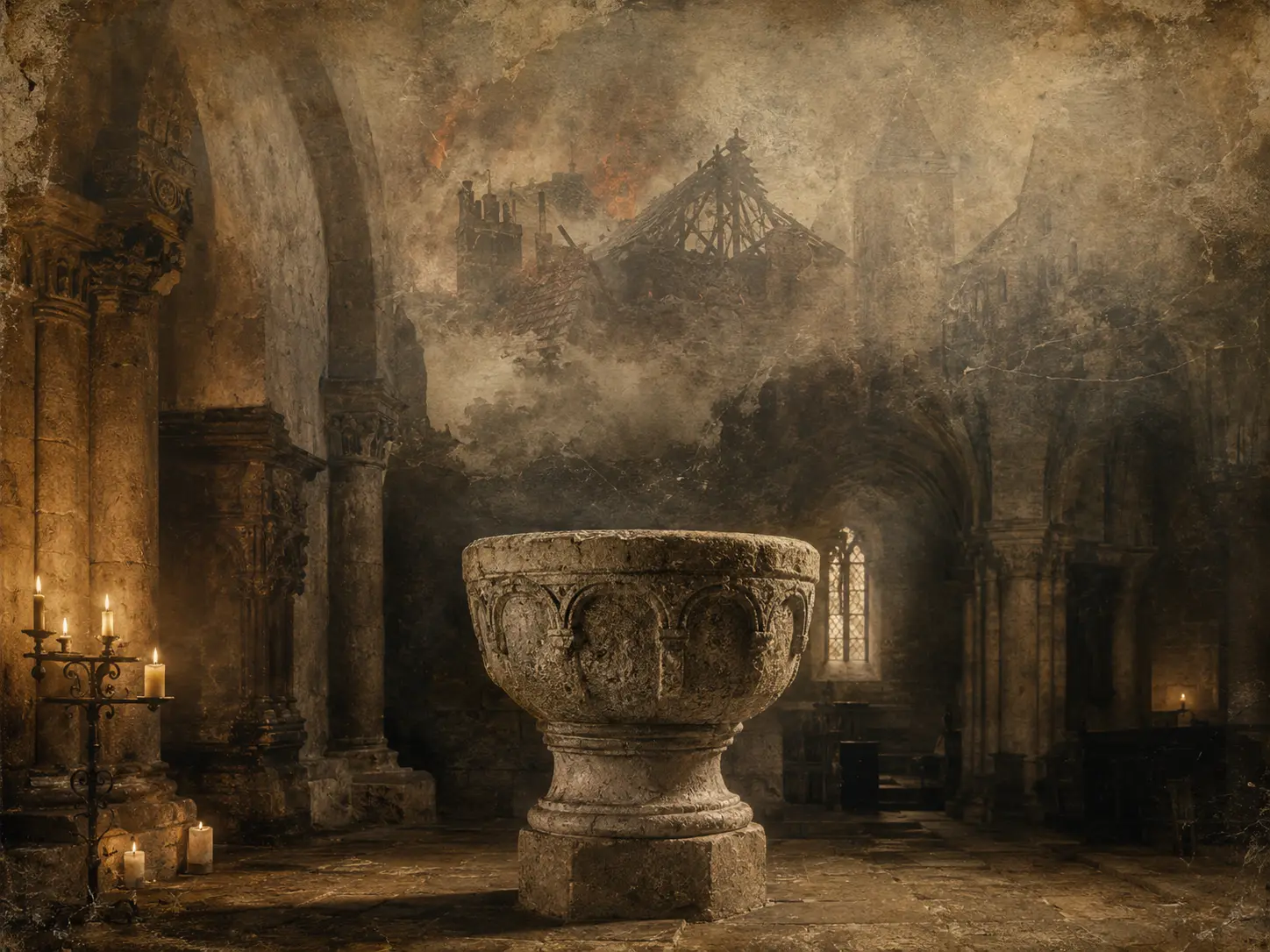
Continuity in stone
The baptismal font of St. Peter and Paul
Bochum’s provost church connects family, city, and church history.
According to the family chronicle, many members of the traditional Friemann line were baptized at its historic font. The stone survived church fires in 1517 and 1920 and became a symbol of continuity for the family.
Featured lines and generations · G01 to G19
Seven portraits between Free Counts, farm, and city
The selection follows formative individuals and couples from Volume 1. The two G18 entries represent two brothers and two different paths within the same generation: Franz continued the farm, while Heinrich Wilhelm entered urban enterprise.
before 1280 – after 1327 · Altenbochum · Hellweg
Sybertus der Vryge of Altenbochum
Sybertus is the earliest ancestor of the family documented in surviving records. A free landowner and Free Count of Bochum, he stands at the beginning of the traceable family history.
before 1342 – after 1359 · Altenbochum · Frielinghausen
Everhardus der Vryge and N. N. of Vrylinghausen
Through office and marriage, Everhardus connected two Bochum families of Free Counts and continued his father’s judicial tradition.
before 1360 – after 1373 · Dortmund · Bockholt
Johannes Vryman of the Buchholte
In 1360, Emperor Charles IV confirmed Johannes as Free Count. He served for at least thirteen years at the royal court seat outside Dortmund.
1797–1864 · 1811–1848 · Altenbochum
Georg Johann Heinrich Friemann and Maria Clementine Dahm
The couple continued the Altenbochum farm during the gradual transformation of the rural Bochum region into an industrial area.
1841–1904 · 1857–1907 · Altenbochum
Franz Friemann and Agnes Siepmann
Eleven children grew up on a farm increasingly surrounded by coal mining, urban growth, and new occupations.
1843–1909 · 1849–1923 · Altenbochum · Bochum
Heinrich Wilhelm Friemann and Agnes Kabeisemann
Franz’s brother left the exclusively agricultural path and, with Agnes Kabeisemann, established a Bochum entrepreneurial family.
1886–1967 · Altenbochum · Bochum · Essen
Heinrich Theodor Friemann
As merchant, archivist, and family historian, Heinrich Theodor preserved the family memory. His research, chronicle, and archival estate remain essential foundations of our work.
Five milestones
Altenbochum in the family chronicle
Sybertus der Vryge
Earliest known documentary reference in Altenbochum.
Everhardus
Recorded as Everd of Altenbochum, called Vryge of Vrilinchusen.
The freehold farm
Hanns Vrymann appears among the Seven Electoral Free Men of the Bochum free court.
The farm burns
The freehold farm and neighboring Puttmann farm are destroyed.
Rebuilding
Elisabeth Mummenhoff and Georg Heinrich Friemann rebuild the farm.
Foundations of our research
Sources and acknowledgments
The principal foundation for this chapter was the collection of the Bochum City Archives—Bochum Center for Urban History. Of particular importance was the estate of Theodor Heinrich Friemann, identified in archival correspondence as “Nachlass Friemann, Heinrich.” The finding aid and materials made available in the reading room gave us direct access to documents central to the family’s history in Altenbochum.
We are especially grateful to the friendly and exceptionally cooperative staff of the Bochum City Archives. They carefully prepared our visit, supplied the finding aid and requested materials, and supported our research with great helpfulness.
Additional historical context came from public information provided by the Kortum-Gesellschaft Bochum e. V.. These sources are brought together and genealogically assessed in Friemann aus Altenbochum—Family Chronicle, Volume 1, fourth edition, 2026, compiled by Jürgen Friemann from the shared family research of Jürgen and Markus Friemann.