A trade instead of the mine
Johann Wilhelm was born in Niederbonsfeld in 1911 and trained as a marble polisher. His trade combined hard physical labor with skilled stonework for monuments and buildings.
G20 · Generation 06 · Niederbonsfeld · Rellinghausen · Steele
Crisis, war, loss, and a new beginning shaped this generation. Their grandchildren Jürgen and Markus Friemann now continue the story through their shared research project.
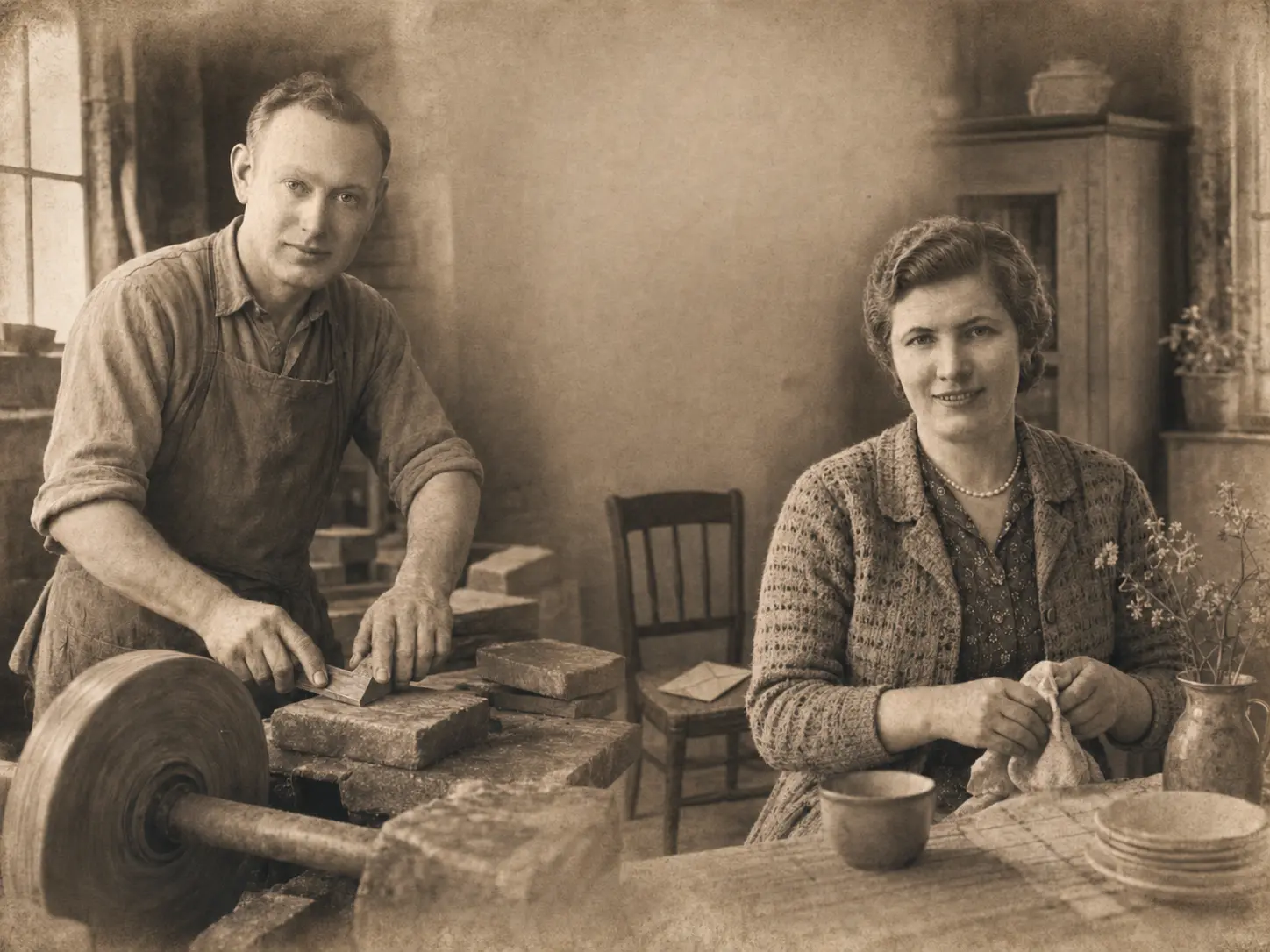
Key facts and family background
Johann Wilhelm grew up as the son of a coal hewer and a factory worker during an era marked by crisis. After the death of his first wife, Hedwig Poburski, he established a new family with Ernestine Schirmer.
Basis: Portraits in the presentation and Family Chronicle, Volume 2; facial references from the family collection
Their story
Origins, marriage, work, and family responsibilities combine to form a portrait of this generation.
Johann Wilhelm was born in Niederbonsfeld in 1911 and trained as a marble polisher. His trade combined hard physical labor with skilled stonework for monuments and buildings.
After the early death of his first wife, Hedwig Poburski, Johann Wilhelm married Ernestine Schirmer in 1933. His daughter Walfriede was from his marriage to Hedwig; Johann Wilhelm and Ernestine had two sons, Hans Willi and Heinz. Ernestine came from a family whose path had led from the Sauerland region to mining work in Essen.
Johann Wilhelm was drafted in 1940. According to the sworn statement made by his comrade Helmuth Raupach on March 16, 1948, his unit was encircled near Shevchenkove in present-day Ukraine. Johann Wilhelm attempted to escape on horseback, was shot from the horse, and was seen dead in the mud with a gunshot wound to the head; his body was never recovered. In 1948, the Essen-Steele Local Court officially declared him dead. That same year, Ernestine married the miner Carl Friedrich Emil Böhle. Their daughter Christa was born from this marriage. Ernestine died in Heiligenhafen in 1999.
Source note This biographical account is based on Family Chronicle, Volume 2. Major foundations include information provided for our research by the Haus der Essener Geschichte/Stadtarchiv and FaZiT – Familienzusammenführung im Team. Historical interpretations and reconstructions are identified as such; information about living descendants is not presented.