His father’s inheritance
Franz lost his mother at six and his father at twenty-two. As estate owner, he continued the Altenbochum farm and remained committed to agriculture during advancing industrialization.
G18 · Altenbochum line · Altenbochum
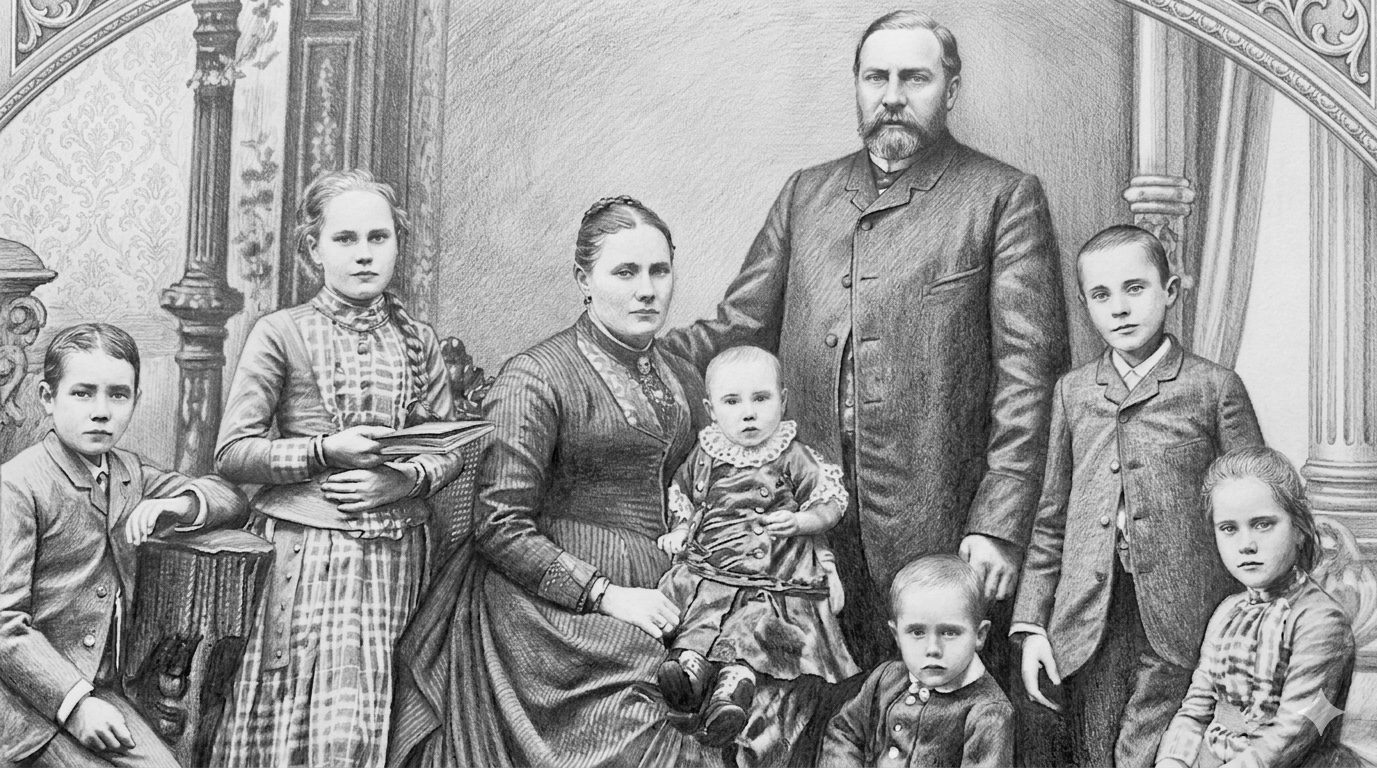
Eleven children grew up on a farm increasingly surrounded by coal mining, urban growth, and new occupations.
Key facts and family background
As estate owner, Franz took over the family’s agricultural operation in Altenbochum. In 1876 he married Agnes Siepmann. Their eleven children reflect the transition from a farming environment to a bourgeois and industrial society.
Basis: Family Chronicle, Volume 1
The biographical account
Documented facts, family relationships, and historical interpretation are kept clearly distinguishable.
Franz lost his mother at six and his father at twenty-two. As estate owner, he continued the Altenbochum farm and remained committed to agriculture during advancing industrialization.
Franz married Agnes Siepmann in Bochum in 1876. Eleven children made the farm a large family household. Many survived childhood, reflecting slowly improving living conditions in the late nineteenth century.
The children followed different paths. Alongside agriculture and estate ownership, the records include a veterinarian and occupations in crafts and commerce. The family remained rooted locally while using the educational and professional opportunities of the German Empire.
Franz preserved the farm as an economic foundation. In 1927 his son Heinrich Friemann the Elder sold land to the church. By then, at the latest, agricultural operations in Altenbochum had ended.
Source note This biographical account follows the presentation and references in Friemann aus Altenbochum—Family Chronicle, Volume 1, fourth edition, 2026. Missing partner names, descendants, and uncertain details remain explicitly identified. Historical reconstructions do not replace individual documentary evidence.