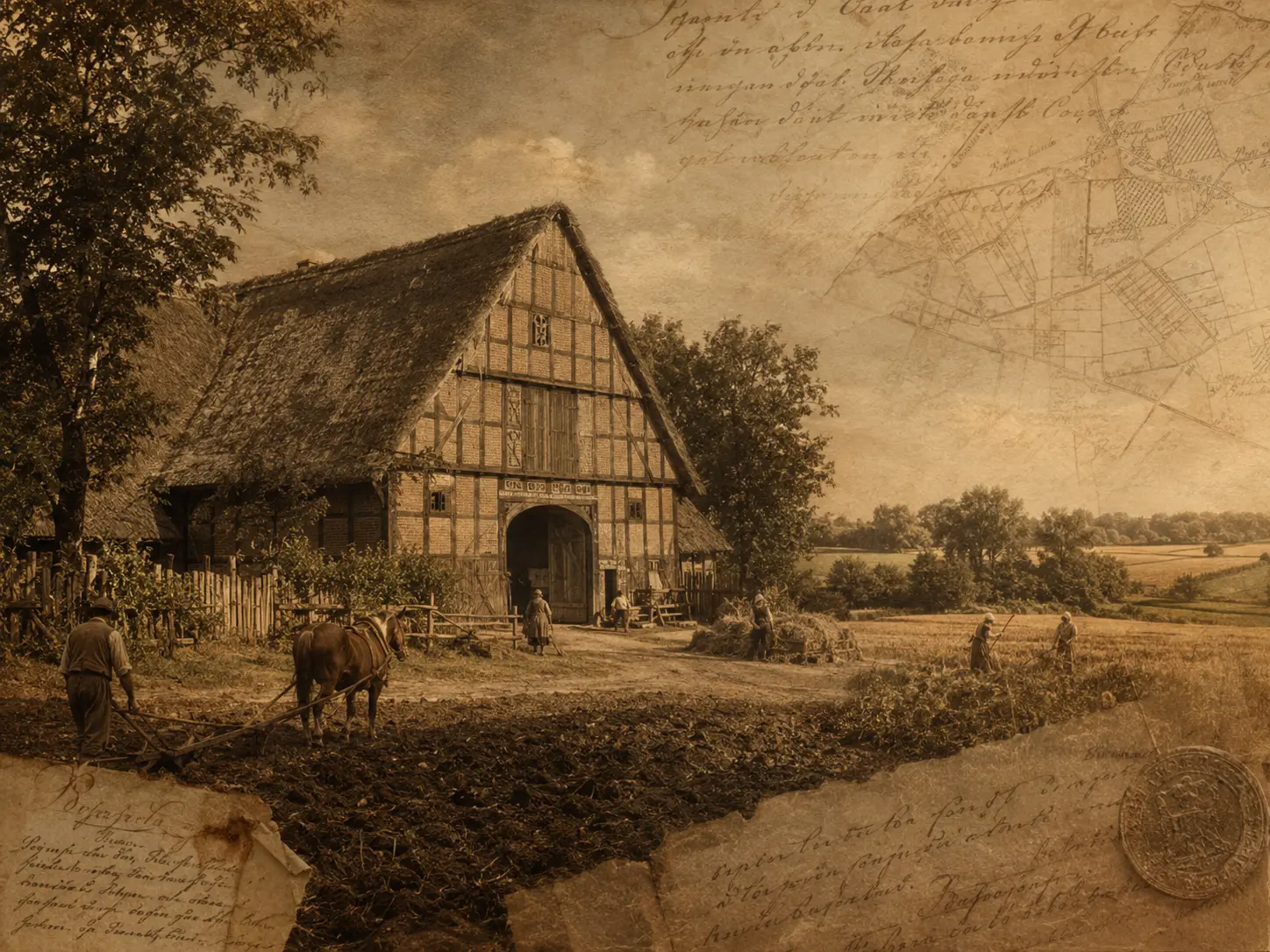
A marriage linked the Friemann farming family of Altenbochum with the Schulte Ising farm in Kray-Leithe. There, Georg Heinrich and Anna Gertrud continued an existing household and established the Essen-Steele line.
The Schulte Ising farm in Kray-Leithe · historical reconstruction
Key facts and family background
G15
1736–1809
Georg Heinrich came from the Friemann farming family of Altenbochum. Anna Gertrud Grüggel was living as a widow with five children on the Schulte Ising farm. Their marriage in 1760 brought together two lives and two families. The couple had three more children together.
Georg Heinrich
June 1736 – 18 February 1809
His parents
Heinrich Friemann the Younger · Anna Elisabeth Wembers
Anna Gertrud
widow of Johann Albert Schulte Ising
Marriage
15 July 1760 · St. Laurentius in Steele
Family
five children from Anna’s first marriage · three children together
Farm role
resident farmholder at Schulte Ising in Kray-Leithe
Basis: Family Chronicle, Volume 2, and the church-register entries evaluated there
Their story
Two lives become one family history
Origins, marriage, work, and family responsibilities combine to form a portrait of this generation.
01
A son from Altenbochum
Georg Heinrich Friemann was born in Altenbochum in June 1736, the son of Heinrich Friemann the Younger and Anna Elisabeth Wembers. He grew up in a farming family whose life was closely tied to the ancestral farm in Altenbochum. As a younger son, however, he was not the immediate successor to his parents’ property.
02
Anna Gertrud and the Schulte Ising farm
Anna Gertrud Grüggel already had a family history of her own when she met Georg Heinrich. Her first marriage to Johann Albert Schulte Ising produced five children. After his death, she remained connected with the farm and responsible for the family. Her later marriage therefore did more than unite two people: it brought Georg Heinrich into an established household and farming community.
03
The marriage of 1760
Georg Heinrich and Anna Gertrud married on 15 July 1760 at the Catholic parish church of St. Laurentius in Steele. For Georg Heinrich, the marriage meant moving from Altenbochum to Kray-Leithe. For Anna Gertrud, it allowed the household and farm to continue after her first husband’s death. Their marriage joined their previous lives into a new family.
04
Friemann, called Schulte Ising
Georg Heinrich took charge of the Schulte Ising farm as its resident farmholder. The surviving records consequently call him ‘Friemann genannt Schulte Ising’ or ‘Fryman gen. Ising.’ Such a farm name expressed a person’s association with a particular holding and the role performed there. It did not replace his Friemann origins, but stood alongside the family name in local usage.
05
A blended family
The five children from Anna Gertrud’s first marriage were joined by three children born to the couple. The farm thus became the center of a blended household. Genealogically, the distinction remains important: the older children belonged to the Schulte Ising marriage, while the couple’s three children continued the Friemann called Schulte Ising line.
06
The beginning of the Essen-Steele line
Georg Heinrich remained connected with Leithe into old age. He died on 18 February 1809 and was buried in the cemetery of St. Laurentius in Steele. The marriage of 1760 marks the decisive transition: a branch of the Altenbochum family became a line whose later path led through Kray-Leithe and Steele and eventually into the mining world.
Season 2 · Episode 1 · The Friemanns in Essen-Steele
A marriage changes the family story
The German-language audio story follows Georg Heinrich Friemann and Anna Gertrud Grüggel from the Friemann farm in Altenbochum to Essen-Kray-Leithe.
Source note This biographical account is based on Family Chronicle, Volume 2. Major foundations include information provided for our research by the Haus der Essener Geschichte/Stadtarchiv and FaZiT – Familienzusammenführung im Team. Historical interpretations and reconstructions are identified as such; information about living descendants is not presented.